The Last Wilderness: Tracking the Ghosts of the Tibetan Plateau
Welcome to the “Roof of the World”—a realm of superlatives where life pushes the boundaries of possibility. The Tibetan Plateau, the world’s highest and most extensive high-altitude region, is not only a landscape of breathtaking beauty but also one of the last great wildernesses on Earth, hosting an extraordinary array of wildlife found nowhere else.
This is the land of the Tibetan antelope (chiru), whose legendary migrations across the Kekexili region are among the most spectacular wildlife events on the planet. This is the domain of the wild yak, a massive Ice Age survivor that roams the windswept plains of the Changtang at altitudes exceeding 5,000 meters. And this is the realm of the elusive snow leopard, the “ghost of the mountains,” whose presence is known more by tracks and scratch marks than by sightings.
Tibet’s wildlife has evolved extraordinary adaptations to survive in this harsh environment—from the antelope’s specialised nasal passages that warm frigid air before it reaches the lungs, to the wild yak’s heart, which comprises 0.6% of its body weight to pump oxygen-rich blood through its massive frame. The Tibetan Plateau is home to over 30 nationally protected species, including the black-necked crane (Tibet’s most elegant avian resident), the Tibetan wild ass (kiang), the Tibetan fox, and the rare white-lipped deer.
This 12-day expedition is designed for nature lovers, wildlife photographers, and conservation-minded travellers who wish to experience these magnificent creatures in their natural habitat. Beginning and ending in Lhasa, we will explore four distinct wildlife zones: the lush forests of Nyingchi, the vast grasslands of the Changtang, the sacred lake basins of Namtso and Yamdrok, and the high-altitude wetlands of Lhoka. Along the way, we will be accompanied by expert local guides who understand animal behaviour, respect ecological protocols, and share a deep commitment to conservation.
Top Tibetan Wildlife Species & Where to Find Them
Species Scientific Name Best Viewing Location Best Season Notes
Tibetan Antelope (Chiru) Pantholops hodgsonii Changtang, Kekexili periphery June–August (migration) Use 400mm+ lens, dawn/dusk activity
Wild Yak Bos mutus Changtang, Purogongri Glacier area, May–October Maintain 500m+ distance, extremely dangerous
Snow Leopard Panthera uncia, Everest region, Nyenchen Tanglha, April–June, Sept–Oct. Requires expert tracking, rare sightings
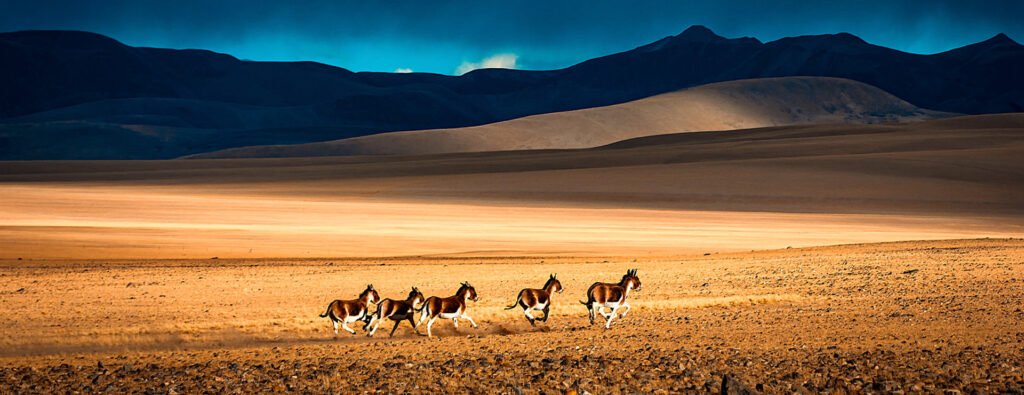
Kiang (Tibetan Wild Ass) Equus kiang Namtso, Changtang Year-round Herds of 50+ possible, best in golden light
Black-necked Crane Grus nigricollis Lhoka (winter), Changtang (summer) Nov–March (winter), May–Aug (breeding) Tibet’s most elegant bird
Tibetan Fox Vulpes ferrilata Namtso, Changtang Year-round Diurnal, often near pika colonies
Blue Sheep (Bharal) Pseudois nayaur Throughout the Himalayas Year-round Primary snow leopard prey
Tibetan Gazelle Procapra picticaudata Lhoka, Changtang Year-round Smaller, paler than chiru
Himalayan Marmot Marmota himalayana Alpine meadows throughout April–October Listen for warning whistles
Bar-headed Goose Anser indicus Namtso, Yamdrok, Summer, Highest-flying bird on Earth
Wildlife Photography Tips for Tibet
Subject Recommended Equipment Best Time Key Technique
Distant mammals 400-600mm lens, tripod Dawn/dusk Use camouflage, stay downwind
Birds in flight 200-400mm, fast shutter speed, Morning Pan smoothly, continuous autofocus
Landscapes with wildlife, 24-70mm, polariser, Golden hour. Include animals inthe environmental context
Night sky with animals Wide-angle, tripod, remote Moonless nights Light painting (with guide’s permission)
⚠️ Critical Photography Rules:
- Never use flash with wildlife—it can permanently damage night vision and startle animals
- Never chase or pursue animals for a better shot—this is illegal and unethical
- Stay on designated paths—off-trail travel damages fragile alpine vegetation
- Do not feed animals to attract them for photos
- Maintain minimum distances: 500m for wild yak, 200m for most other mammals, 50m for birds
- Drones are strictly prohibited in all wildlife areas and will be confiscated
Legal & Ethical Framework
Required Permits
Permit Type Required For Application Time
Tibet Travel Permit (TTP) All foreign travellers 20-30 days
Alien’s Travel Permit: Travel beyond Lhasa for 30 days
Military Permit Changtang, border regions 30-45 days
Wildlife Observation Permit Special reserves 30 days (limited availability)
Wildlife Protection Laws
Under the Tibet Autonomous Region Implementation of the “Wild Animal Protection Law of the People’s Republic of China” Measures (2025 revision):
- Hunting protected species: Criminal penalties, including imprisonment
- Disturbing wildlife: Fines up to 10,000 RMB
- Entering core protected areas: Fines up to 50,000 RMB per individual, 200,000 RMB per group
- Using prohibited methods: Confiscation of equipment, potential criminal charges
Ethical Wildlife Watching Guidelines
- Maintain distance—use binoculars and telephoto lenses
- Stay quiet—loud noises stress animals
- Never feed wildlife—it alters natural behaviour
- Stay on roads and trails—off-road driving destroys habitat
- Report poaching—note the location and contact your guide immediately
- Carry out all trash—wildlife can be harmed by litter
- Respect breeding seasons—avoid areas with young animals
.
CRITICAL LEGAL NOTE: All wildlife viewing in Tibet is strictly regulated to protect sensitive species and their habitats. Our tours operate only in legally accessible areas with all required permits, following the “zero disturbance” principle. Illegal entry into core protected areas carries severe penalties, including fines up to 50,000 RMB and potential criminal charges.
- Duration: 12 Days / 11 Nights
- Start/End City: Lhasa, Tibet Autonomous Region
- Physical Rating: Moderate to Challenging (High altitude, long drives)
- Max Altitude: 5,200m (Everest Base Camp) / 5,190m (Namtso La Pass)
- Best Season: May–October (peak wildlife activity)
- Group Size: Small groups (1-15 travellers) for minimal environmental impact
Highlights
- Witness the Tibetan Antelope in its Realm: Observe endangered chiru in the grasslands of the Changtang and Kekexili periphery, with peak viewing during the June–August migration season.
- Encounter the Mighty Wild Yak: Track purebred wild yak herds on the northern plateau, maintaining a safe 500-meter distance while observing these 1-ton giants through high-powered optics.
- Search for the Elusive Snow Leopard: In the Everest region and Nyenchen Tanglha range, learn tracking techniques from local experts and, with luck, glimpse the "ghost of the mountains".
- Observe the Elegant Black-necked Crane: Visit wintering grounds in Lhoka and summer breeding areas in the Changtang to witness Tibet's most cherished bird performing its graceful courtship dances.
- Photograph Tibetan Wild Ass (Kiang): Capture images of these beautiful equids galloping across the grasslands, their russet coats gleaming in the golden light.
- Explore Biodiversity Hotspots: From the subtropical forests of Medog to the alpine meadows of the Changtang, experience the full spectrum of Tibetan ecosystems.
- Learn from Conservation Heroes: Meet wildlife rangers and protection station volunteers who dedicate their lives to safeguarding Tibet's natural heritage.
- Practice Ethical Wildlife Photography: Under expert guidance, learn to capture stunning images while maintaining safe distances and never disturbing natural behavior.